
← The Growth Lab · AGENTIC COMMERCE
The Four Gates: Can AI Find, Understand, Justify and Select Your Product?
Oct 19, 2026 · Read time: 3 min · DV8 Pacific
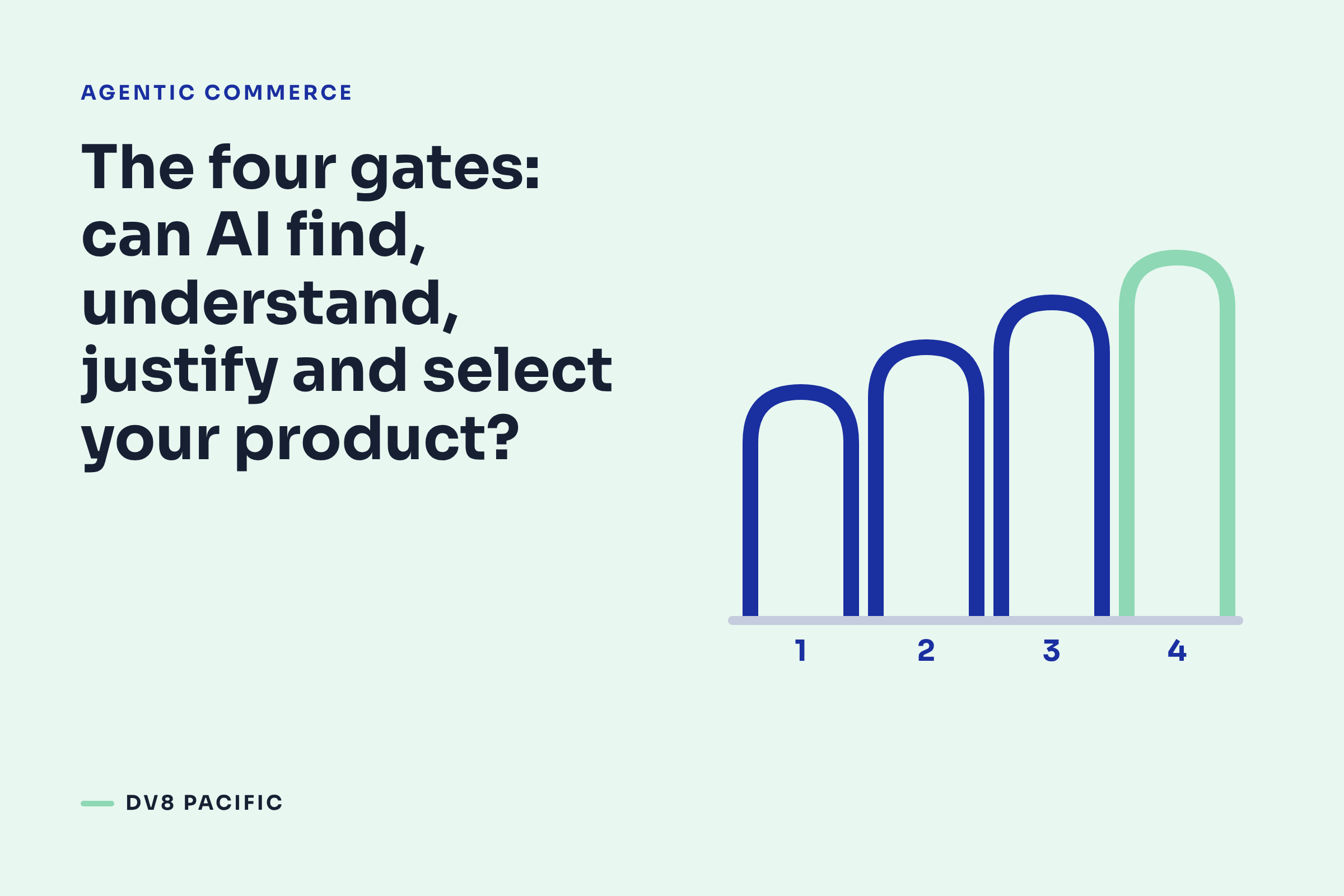
Before an AI assistant recommends a product, or adds it to a shopper's cart, it has to clear four gates. They run in order, and failing an early gate blocks everything after it. Many brands invest heavily in content and reviews without realizing their products fail the very first gate.
Gate one: Find
The AI's question: Can I access and read this product?
This is a technical gate. Common failures include website security or bot-management rules that block AI crawlers, product details that only load after JavaScript runs, and the absence of structured data. Structured data, usually written as JSON-LD using the Schema.org vocabulary, labels each fact on the page: this is the product name, this is the price, this is the stock status, this is the rating. Without it, an AI has to guess these facts from the visible text, which is unreliable.
The fix: confirm that the main AI crawlers, including GPTBot, OAI-SearchBot, ClaudeBot, PerplexityBot and Google-Extended, are not blocked. Add Product structured data to every product page, and make sure it appears in the page's initial HTML rather than being injected later.
Gate two: Understand
The AI's question: Can I match this product to how people describe their needs?
Shoppers describe situations, not product codes. If a product page only contains slogans or a short translated description, the AI cannot connect it to "a mild hot sauce for kids" or "a moisturizer for dry winter skin." Missing attributes such as size, origin, ingredients, spice level or dietary information make matching harder still.
The fix: write product content in natural English around use cases and occasions, and fill in every attribute.
Gate three: Justify
The AI's question: Can I defend choosing this product over the alternatives?
An AI that recommends a product must be ready for the follow-up: why this one and not that one? It looks for evidence: ratings and review counts, consistent pricing, clear differentiators and claims it can verify. Structured data must also be accurate; ratings or prices that do not match what the shopper sees undermine trust.
The fix: build a credible base of US reviews, keep pricing consistent across retailers, and make sure every claim can be supported.
Gate four: Select
The AI's question: Is this product available and easy to buy right now?
The most persuasive product page fails if the item is out of stock, if there is no clear place to buy it, or if the shopper's region is not served.
The fix: keep product feeds updated with price and stock at least daily, list clearly where to buy, and protect stock of hero products.
A five-minute self-check
Open one of your product pages, view the page source and search for "application/ld+json." If nothing appears, AI agents receive no structured product data from that page. Confirm with Google's Rich Results Test or the Schema.org validator, then check a sample of pages across templates and stock states.
Sources: Schema.org Product, Offer and AggregateRating documentation; Google Search Central, Rich Results Test; OpenAI, Anthropic, Perplexity and Google crawler documentation; DV8 Pacific analysis.