
← The Growth Lab · RETAIL MEDIA
Retail Media Meets AI: Why Retailers and AI Platforms Need Each Other
Oct 11, 2026 · Read time: 3 min · DV8 Pacific
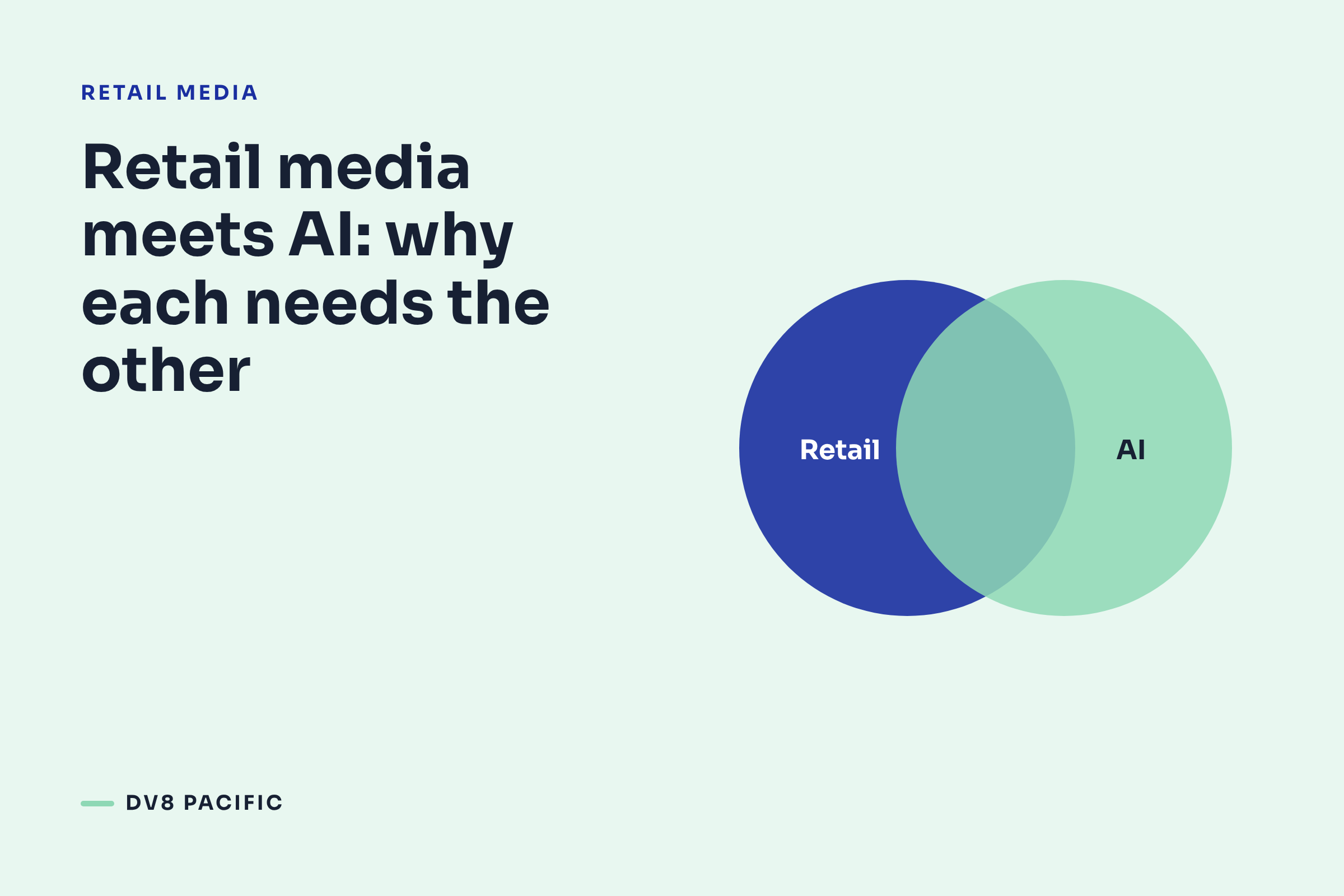
Retail media and AI advertising are often discussed as competitors for the same budgets. In practice, they know different things about shoppers, and the most effective setups are starting to connect them.
Retailers know what people buy
Retail media's core strength is transaction data. A retailer can connect an ad exposure to a purchase, down to the specific product, and report sales in a closed loop. It knows purchase history, basket composition and repeat behavior. Its limitation is reach before the shopper arrives: a retailer mostly sees its own shoppers once they are already shopping.
AI assistants know why people are deciding
AI platforms see something retailers do not: the reasoning before the purchase. In a conversation, shoppers describe their needs, constraints, budgets and comparisons. Its limitation is the reverse of retail's: an AI platform usually does not see what was bought at the retailer afterward.
Put simply, one knows what people buy, and the other increasingly knows why they are trying to decide.
The connection is already forming
The two are beginning to meet. Amazon Ads has announced a pilot that lets select advertisers extend campaigns into ChatGPT. Criteo, a retail media technology provider, has built an integration with OpenAI. Target's Roundel has tested ChatGPT advertising for Target and its brand partners. At the same time, retailers are turning their own assistants into ad inventory, with Amazon's sponsored prompts and Walmart's advertising around Sparky.
The closed loop across both
The most valuable setup combines the strengths of each. An AI ad reaches a shopper while they are deciding. The click goes to a retailer's product page. The purchase is recorded in the retailer's data. With privacy-safe matching, the brand can learn whether AI exposure led to added sales at that retailer. This is especially relevant for consumer packaged goods, where most sales happen at retailers and a brand's own website has little purchase data to measure against.
Where retail media is heading
As AI assistants start to build baskets and complete purchases, retail media will evolve from buying placements on a results page toward taking part in AI-driven shopping decisions. Likely formats include sponsored selections within agent recommendations, sponsored alternatives ("you might also consider"), sponsored shopping missions ("planning hot pot tonight?") and ads inside retailers' own assistants.
What brands should do now
Treat AI and retail media as one plan, not two. Use AI campaigns to learn which shopper needs drive interest, and send that traffic to retailer pages where sales can be measured. Ask retail media partners whether they offer AI placements and how they connect exposure to sales. Keep product data consistent across retailers, because both retail search and AI assistants depend on it.
Sources: Amazon Ads, "New integration to support advertising in ChatGPT," 2026; Criteo, "An update on Criteo's integration with OpenAI," May 2026; Target, "Target and Roundel test advertising in ChatGPT," February 2026; DV8 Pacific analysis.