
← The Growth Lab · AI SHOPPING
How AI Became the Shopper’s Shortlist
Oct 28, 2026 · Read time: 3 min · DV8 Pacific
For twenty years, the path to purchase in the US was simple: search, click through to a retailer, buy. That path has broken into pieces. Today a shopper might see a product on social media, search for it on Google, read a Reddit thread, check prices on Amazon and Walmart, and then open an AI assistant to ask the question that actually decides the purchase: which one should I buy?
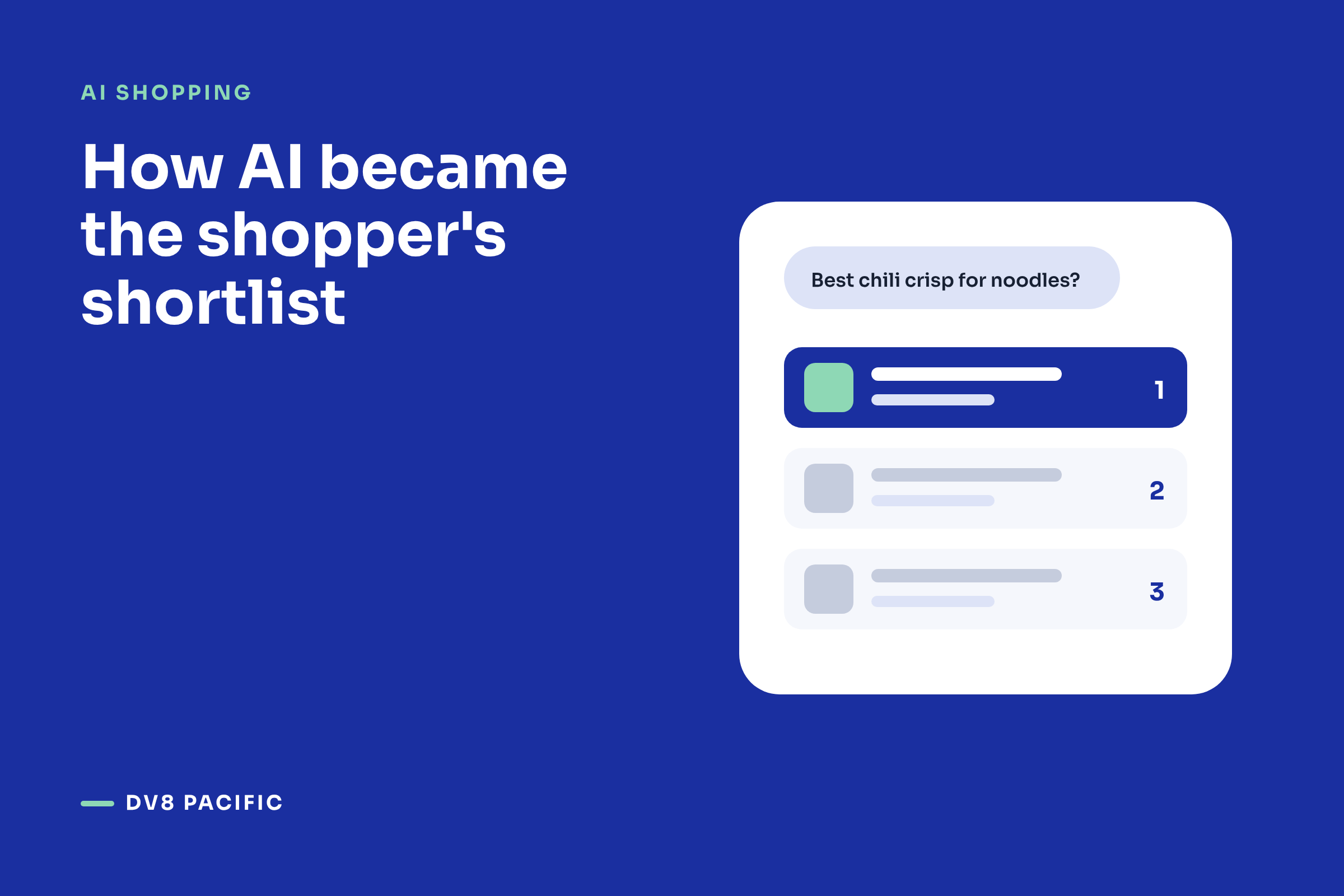
That question used to be answered by friends, reviews and store staff. Increasingly, it is answered by ChatGPT, Gemini, Google's AI Mode or Amazon's shopping assistant. The assistant does not return ten blue links. It returns a short list of names, often with a clear favorite. For many shoppers, that list becomes the shortlist.
The middle of the funnel has moved
AI has not replaced search or retail. Shoppers still use both, and they use AI alongside them. What AI has taken over is the comparison stage in the middle of the journey, where people narrow their options and form a preference. Panel research presented by Similarweb in 2026 found that shopping sessions involving an AI assistant had grown about two and a half times, with the impact concentrated in exactly this stage.
That matters because the middle of the funnel is where unfamiliar brands win or lose. A shopper who already knows a brand asks for it by name. A shopper who asks "which chili crisp is good on noodles and not too oily" is open to suggestion. Whichever brands the AI names in that moment get considered. The others never enter the decision.
AI shoppers arrive ready to buy
Traffic from AI assistants to retail sites is still a small share of the total, but retail analytics providers report that it is growing quickly and converts better than average. The reason is simple. By the time a shopper clicks through from an AI answer, the research is done. They have compared options, read summaries of reviews and settled on a choice. They arrive to buy, not to browse.
Advertising has followed the shopper
Where shoppers go, ad budgets follow. According to research from Graphite and Similarweb, ChatGPT advertising reached a $1 billion annualized revenue run rate within its first 200 days, with tens of thousands of advertisers. Google is testing ads and promotional offers inside AI Mode. Amazon sells sponsored prompts inside its shopping assistant, and Walmart is building advertising around its assistant, Sparky. AI conversations are now a media channel with real money behind it.
What this means for brands
For established US brands with large teams and agencies, AI shopping is one more channel to manage. For Asian brands selling in the US and for local Asian businesses, it is both a risk and an opening. The risk is invisibility: brands with thin English content, few US reviews or unstructured product data are easy for AI to overlook. The opening is that AI answers are not yet locked up by the biggest advertisers, and a brand that is clearly described and well reviewed can earn a place on the shortlist regardless of size.
The first step is to find out where you stand. List the 20 to 30 questions your customers actually ask about your category, in their own words. Ask them across ChatGPT, Gemini, Google AI Mode and Amazon. Record which brands are named, which are recommended and which sources the AI cites. The gaps usually point directly to what needs fixing first.
Sources: Graphite and Similarweb, "The State of ChatGPT Ads," September 2026; Similarweb and Graphite, "ChatGPT Ads Playbook" webinar, 2026; Adobe, AI-sourced retail traffic reports, 2025–2026; Google, Amazon and Walmart product announcements, 2026.