
← The Growth Lab · US GROWTH
From Core Shoppers to the Mainstream: The US Growth Path for Asian Brands
Oct 27, 2026 · Read time: 3 min · DV8 Pacific
US demand for Asian food and beauty is no longer a niche story. Industry data shows Asian packaged foods growing faster than the US packaged food market as a whole, national grocers expanding their Asian ranges, and the US becoming one of the most important export markets for Korean beauty brands. Younger American shoppers increasingly treat these flavors and products as familiar.
Yet many Asian brands that enter the US grow quickly at first, then stall. In our experience, the cause is rarely the product or the budget. It is the order in which the brand tries to grow.
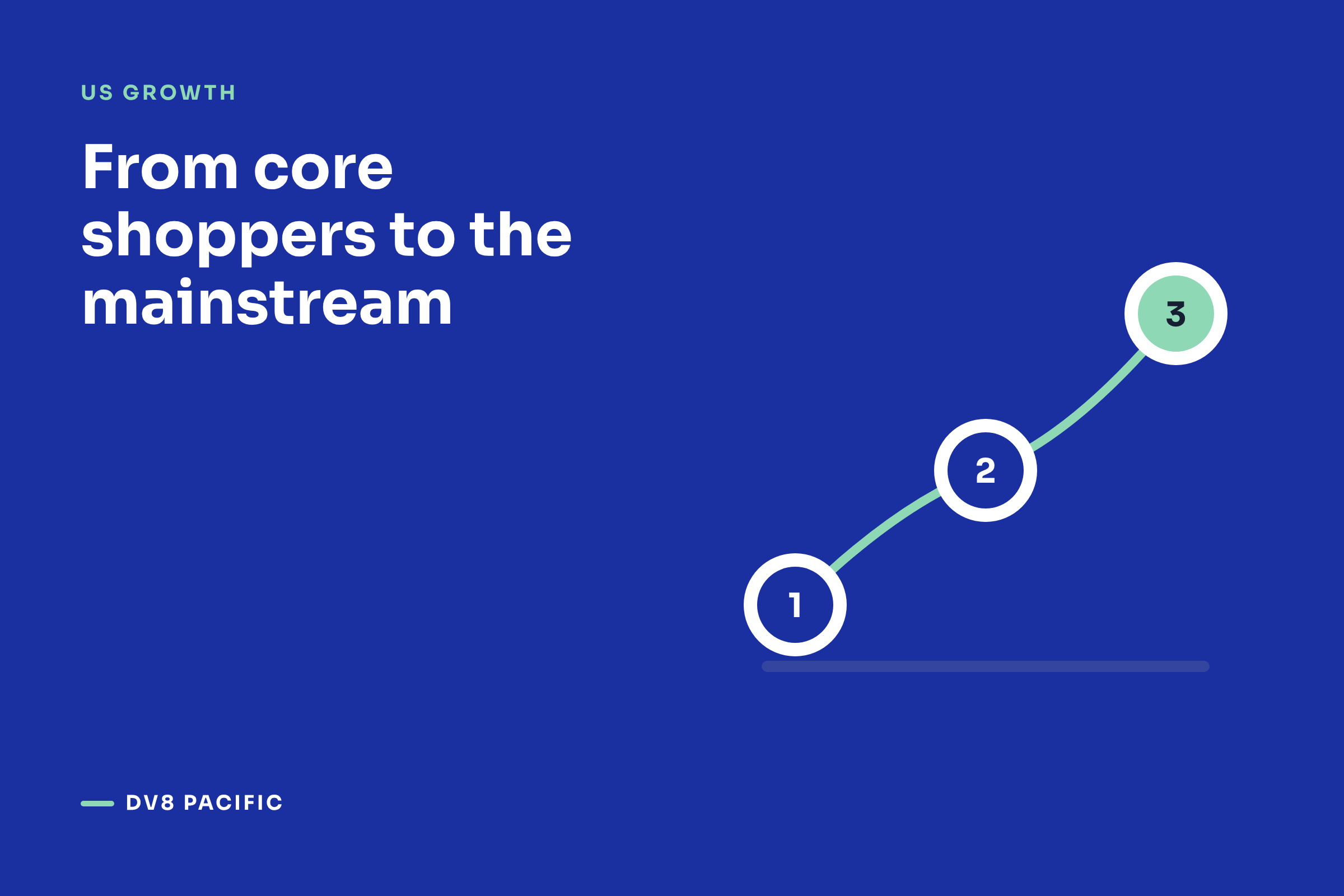
Three stages of US growth
Stage one: core shoppers. Asian-American households who already know the brand from home. Growth comes through specialty grocers, Amazon and community channels, and the product needs little explanation.
Stage two: category enthusiasts. Shoppers exploring Asian flavors or K-beauty who do not yet know the brand. They need education: how to use the product, what it pairs with, why it is better than the alternative. Reviews and AI visibility matter most here.
Stage three: mainstream category buyers. Everyday buyers of sauces, snacks or skincare at national retailers. Here the brand competes directly with established US brands on shelf placement, price, retail media and broad awareness.
Early success can send a false signal
Strong sales among core shoppers prove the product works for one group. They do not prove mainstream demand. A brand that reads early traction as proof of national potential often expands distribution or media too fast and runs into a wall.
The same trap appears in performance data. High returns from Amazon ads, branded search and retargeting often come from existing fans and demand that was already there. They look like growth in a dashboard. The question that matters is how many buyers are genuinely new to the brand.
Each stage needs a different playbook
Moving from one stage to the next changes the message, the channels and the economics. Core shoppers respond to familiarity and availability. Enthusiasts respond to education and proof. Mainstream buyers respond to convenience, price and trust built over time.
Acquisition costs rise as a brand moves outward. Reaching shoppers who are new to the category costs more than reaching people who already buy it. A rising cost per new customer can be a sign the strategy is working, as long as it is judged against the right goal and audience.
Hero products open the door
Most brands do not move into the mainstream with their full range. They lead with one or two hero products that are easy to understand, easy to try and distinctive enough to talk about. Choosing them deliberately, and giving each a clear use case for US shoppers, is one of the highest-leverage decisions a brand can make.
Where to start
Split your current US sales into existing fans and new customers. Identify which stage your brand is really in. Choose the hero products that will carry you to the next stage, and build the message, channels and measurement for that stage before moving on.
Sources: Circana, US packaged food sales data, 2024, as reported by Just Food; BDA Partners, "Asian Food in North America," August 2025; Korea trade data on cosmetics exports, 2025–2026, as reported by Personal Care Insights; DV8 Pacific analysis.